10 Minute Email: The Best Temporary Email Address for Privacy & Quick Sign-Ups

Have you ever visited a website that required an email address just to download something, read an article, claim a trial, or access a service? Giving your personal email address to every website can quickly fill your inbox with newsletters, promotional messages, notifications, and unwanted emails.
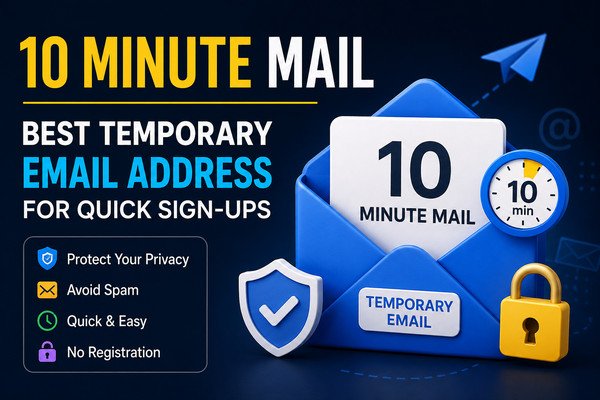
This is where 10 Minute Email and other temporary email services can be useful. A temporary email address gives you a short-lived inbox that can receive emails without requiring you to use your primary personal email account.
In this guide, we’ll explain what 10 Minute Email is, how temporary email addresses work, their advantages and disadvantages, common use cases, privacy considerations, and when you should—and should not—use one.
What Is 10 Minute Email?
10 Minute Email is a type of disposable or temporary email service designed to provide users with an email address that remains available for a limited period.
The concept is simple: instead of entering your permanent Gmail, Outlook, or other personal email address, you use a temporary address when a website only needs an email for a short-term purpose.
Typically, the temporary inbox can receive messages such as:
- Verification emails
- Confirmation links
- One-time codes
- Download links
- Temporary notifications
- Trial or registration messages
The exact expiration time and features vary between providers. Some services automatically extend the mailbox when you request additional time, while others delete the address and messages after a fixed period.
Why Do People Use Temporary Email Addresses?
Your email address is often requested by websites, apps, online stores, forums, newsletters, and promotional services. While some requests are legitimate, giving your main email address to every service can create unnecessary clutter.
A temporary email address can act as a buffer between your personal inbox and websites you don’t fully trust or don’t expect to use regularly.
For example, imagine you want to download a free resource from an unfamiliar website. The website asks for your email address before providing the download.
Instead of immediately giving your primary email address, you may use a temporary inbox if the website’s terms and the purpose of the registration allow it.
10 Minute Email Features
Temporary email services are generally built around convenience and short-term use. Common features include:
1. Instant Email Address
Most temporary email services generate an address automatically. You usually don’t need to create a traditional account or choose a password.
2. Temporary Inbox
Messages are delivered to a temporary inbox rather than your normal personal mailbox.
3. Short-Term Availability
The address is designed to exist for a limited amount of time. Once the expiration period ends, the mailbox may become unavailable.
4. No Long-Term Inbox Management
Because the address is temporary, you don’t normally need to manage it like a regular email account.
5. Useful for Verification
Some websites send a verification message before allowing you to continue. A temporary inbox can receive such messages when the service permits disposable addresses.
How Does 10 Minute Email Work?
Using a temporary email service is generally straightforward.
Step 1: Open a temporary email service
Visit a reputable temporary email provider.
Step 2: Receive a temporary address
The service generates an email address for you.
Step 3: Copy the address
Copy the temporary address and enter it into the website’s email field.
Step 4: Check the temporary inbox
If the website sends an email, it should appear in the temporary inbox.
Step 5: Open the verification email
If appropriate, open the message and use the verification link or code.
Step 6: Let the address expire
After you finish your short-term task, the address can expire according to the provider’s retention policy.
Keep in mind that the exact process differs from one temporary email provider to another.
Benefits of Using a Temporary Email Address
There are several reasons people choose disposable email services.
Reduce Inbox Clutter
One of the biggest advantages is avoiding unnecessary emails in your primary inbox.
If a website sends promotional messages after registration, those messages won’t necessarily reach your normal email account when you use a temporary address.
Protect Your Primary Email
A temporary email can reduce the number of websites that receive your personal email address.
This can be especially useful when interacting with unfamiliar websites where you don’t want to share your primary address.
Quick and Convenient
Traditional email accounts require registration, passwords, recovery options, and account management. Temporary email services are usually much faster for short-term situations.
Useful for Testing
Developers, testers, and users may sometimes need disposable addresses when testing email-related workflows in environments where temporary accounts are permitted.
However, production systems and real customer accounts should generally use appropriate permanent email accounts.
Avoid Unwanted Marketing
Temporary email addresses can help separate one-time registrations from your primary inbox, reducing unwanted marketing messages.
Disadvantages of 10 Minute Email
Temporary email isn’t perfect. There are important limitations you should understand before using it.
Messages May Disappear
The biggest limitation is that temporary inboxes aren’t designed for long-term storage.
Once the address expires, you may lose access to the messages.
Not Suitable for Important Accounts
You should generally avoid temporary email addresses for accounts you need to recover later.
For example, don’t use a disposable address for important services such as:
- Banking
- Financial accounts
- Government services
- Healthcare portals
- Primary social media accounts
- Password managers
- Important business accounts
If you lose access to the temporary inbox, recovering the account could become difficult or impossible.
Some Websites Block Temporary Email
Many websites recognize disposable email domains and prevent users from registering with them.
Therefore, a temporary email address won’t work everywhere.
Privacy Isn’t Guaranteed
A temporary email service should not automatically be considered completely anonymous or private.
The provider may have its own logging, retention, technical, or privacy policies. Before using a service for anything sensitive, review its privacy policy and understand what information it collects.
Shared or Reusable Addresses Can Be Risky
Some disposable email systems may have limited authentication or publicly accessible inbox characteristics. If another person can access the same mailbox, sensitive information could potentially be exposed.
Never use a temporary inbox for confidential communications.
Is 10 Minute Email Safe?
The answer depends on how you use it and which provider you choose.
Temporary email can be relatively useful for low-risk, short-term activities, but it should not be treated as a secure replacement for a normal email account.
The safest approach is to use temporary email only for situations where losing the inbox or its contents would not cause significant damage.
For example, receiving a basic confirmation email is very different from receiving a password reset link for an important financial account.
Safety Tips
Follow these simple precautions:
- Never use temporary email for sensitive financial information.
- Don’t use it as the recovery email for an important account.
- Don’t send confidential information through a disposable inbox.
- Check the provider’s privacy policy.
- Avoid entering sensitive personal information unnecessarily.
- Remember that temporary doesn’t automatically mean anonymous.
- Use reputable services and keep important accounts connected to a permanent email address.
Temporary Email vs. Regular Email
The main difference is persistence.
A regular email account is designed for long-term communication. You can keep the address for years, store messages, reset passwords, and use it for account recovery.
A temporary email address is designed for short-term communication.
| Feature | Temporary Email | Regular Email |
|---|---|---|
| Long-term use | Usually no | Yes |
| Temporary inbox | Yes | No |
| Account recovery | Poor choice | Suitable |
| Personal communication | Not recommended | Recommended |
| Short-term verification | Often useful | Yes |
| Important accounts | Not recommended | Recommended |
| Inbox lifespan | Limited | Usually long-term |
| Setup | Usually very fast | Requires account creation |
When Should You Use 10 Minute Email?
A temporary email address can be appropriate for low-risk situations where you don’t need the address again.
Some examples include:
One-Time Downloads
If a website requires an email before providing a free resource, a temporary address may be useful when permitted by the site’s terms.
Testing Websites
Temporary email can be useful for testing registration and email verification functionality in appropriate testing environments.
Avoiding Unnecessary Subscriptions
If you don’t want your main inbox filled with promotional messages from a service you don’t expect to use regularly, a disposable address may help.
Short-Term Access
For a service that you only need briefly, temporary email may be convenient, provided the service permits it.
When Should You Avoid Temporary Email?
There are situations where using a disposable address is a bad idea.
Avoid temporary email when:
- You need permanent account recovery.
- You are creating a financial account.
- You are registering for an important government service.
- You expect ongoing communication.
- You need to access the account months later.
- The account contains sensitive personal information.
- You need to prove long-term ownership of the email address.
In these cases, use a reliable permanent email account instead.
Best Practices for Temporary Email
If you decide to use 10 Minute Email or another disposable email service, use it responsibly.
Choose the Right Purpose
Before entering the temporary address, ask yourself: “Will I need this email address again?”
If the answer is yes, a permanent email account or a dedicated secondary email account may be better.
Don’t Store Sensitive Information
A temporary inbox isn’t the right place for confidential documents, financial information, personal identification, or sensitive correspondence.
Read the Service’s Terms
Some websites prohibit disposable email addresses. Always follow the website’s registration rules and terms of service.
Keep Important Accounts Separate
Use a permanent email account for services where account recovery and long-term access matter.
Are Temporary Email Addresses Legal?
Using a temporary email address is not inherently illegal. However, what matters is how you use it.
A temporary email address should not be used to commit fraud, impersonate another person, evade legitimate security controls, abuse online services, or violate a website’s terms.
For ordinary privacy-conscious, low-risk registrations, temporary email can be a useful tool.
Frequently Asked Questions
What is 10 Minute Email?
10 Minute mail refers to a temporary email service that provides a short-lived email address for receiving messages without using your permanent email account.
Does 10 Minute Mail really last 10 minutes?
The duration depends on the specific service. Some providers use a roughly ten-minute expiration period, while others allow the user to extend the inbox.
Can I receive verification emails?
Many temporary email services can receive verification messages, but some websites block disposable email domains.
Can I send emails from a temporary address?
Features vary by provider. Some temporary email services are primarily designed for receiving messages rather than long-term email communication.
Is temporary email completely anonymous?
No. Temporary email should not automatically be considered completely anonymous. Provider policies, technical logs, IP information, browser data, and other factors can affect privacy.
Can I use temporary email for banking?
You should not use a temporary email address for banking or other important financial accounts because you may need the address for account recovery and security notifications.
Is 10 Minute Mail free?
Many temporary email services offer basic temporary inbox functionality without requiring payment, although features and pricing can vary by provider.
Final Thoughts
10 Minute Email and similar temporary email services can be useful when you need a quick, disposable email address for a low-risk, short-term purpose.
The biggest advantage is convenience: you can keep one-time registrations, verification messages, and promotional communications away from your primary inbox. However, temporary email has important limitations. Addresses can expire, messages may disappear, some websites block disposable domains, and privacy isn’t guaranteed.
The key is knowing when to use it. For a simple one-time interaction, a temporary email address can be convenient. For banking, account recovery, healthcare, government services, business-critical accounts, or anything important, use a permanent and trustworthy email account.